Stronger proposals with less effort
Origami turns dense solicitations into cited checklists, coordinates the proposal workflow, and reviews drafts before submission.
Build checklist
Collect documents
Run a review

Proposaldevelopmentiswhereproblemspileup...butit'salsowherethebiggestopportunitylies
Proposaldevelopmentiswhereproblemspileup...butit'salsowherethebiggestopportunitylies
Proposaldevelopmentiswhereproblemspileup...butit'salsowherethebiggestopportunitylies
Today
Fire drills, follow-ups, and proposals that fall short.
Grant complexity is growing, timelines are shrinking, and Research Administration teams are being asked to do more with less. AI chatbots feel like they should be the solution, but maintaining them is another full-time job.
30+ hours spent per proposal
30+ hours spent per proposal
200+ pages read manually
200+ pages read manually
<20% of proposals get support
<20% of proposals get support
2 weeks for an external review
2 weeks for an external review

With Origami
Stronger proposals with less effort.
AI operationalized specifically for research administration means no more digging through dense solicitations or scrambling at the last minute. Submitted proposals are of higher quality and more responsive, increasing overall competitiveness.
15+ hours saved per proposal
15+ hours saved per proposal
1 place for requirements, docs, and tasks
1 place for requirements, docs, and tasks
100% of proposals get personalized support
100% of proposals get personalized support
<5 minutes to run a review
<5 minutes to run a review


"Origami helps our stretched team cover more ground. It gives our newer admins a head start on requirements and takes routine work off everyone else's plate, so people can spend their time on what actually matters. And when a proposal reaches us at the last minute, Origami's review gives us one more chance to catch problems before it's submitted."
Amy Thomas, Director of Research Programming
Submission readiness, from day one
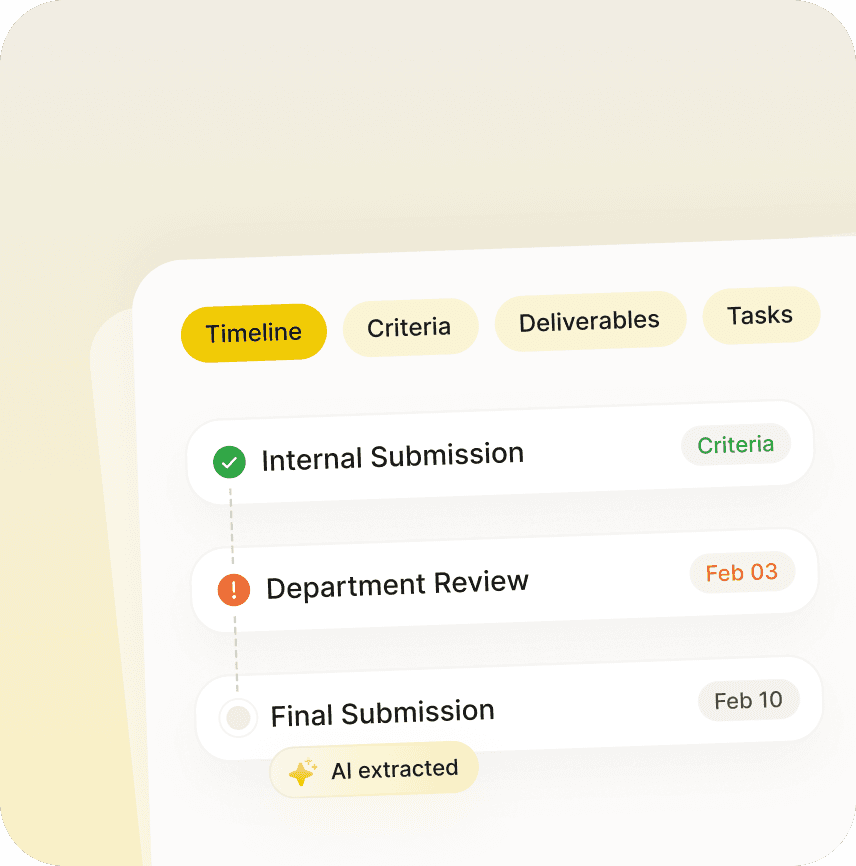
Extract, organize, and link the key criteria from a funding opportunity before any drafting begins.
•
Internal and external deadlines
•
Explicit and implicit requirements
•
Budget and compliance
•
Deliverable list with owners
Keep the entire team aligned and moving
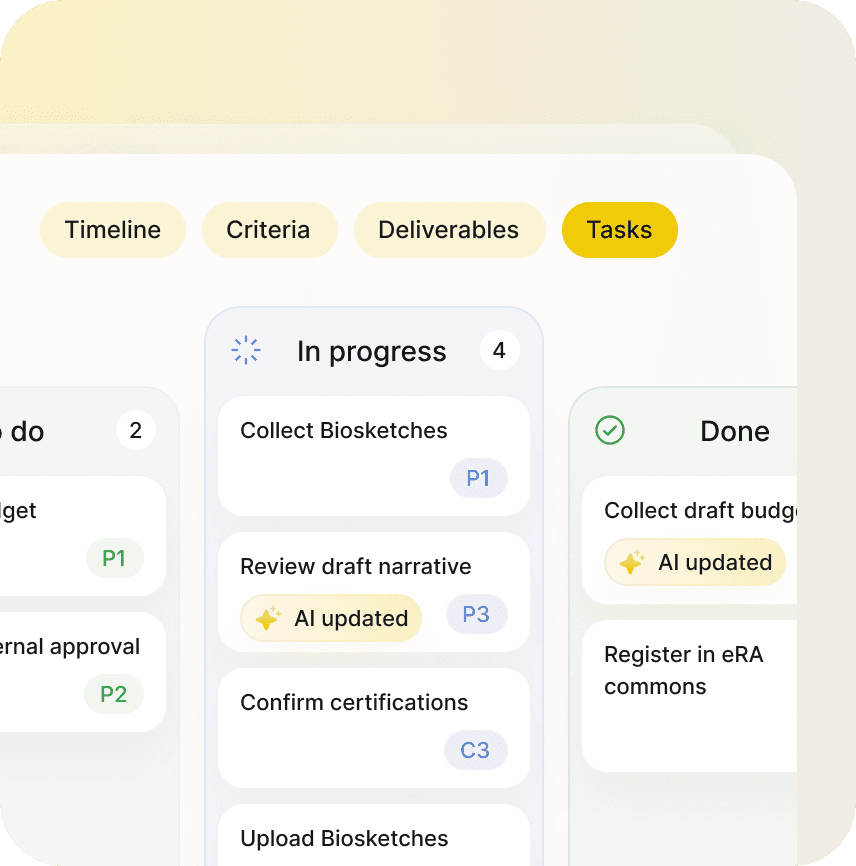
One coordination layer for requirements, drafts, owners, and deadlines to ensure timely submission.
•
Personalized views for each stakeholder
•
Create, assign, and track task completion
•
Automated reminders and document collection
•
Track workflows with an AI-assisted inbox
Catch compliance & quality issues early
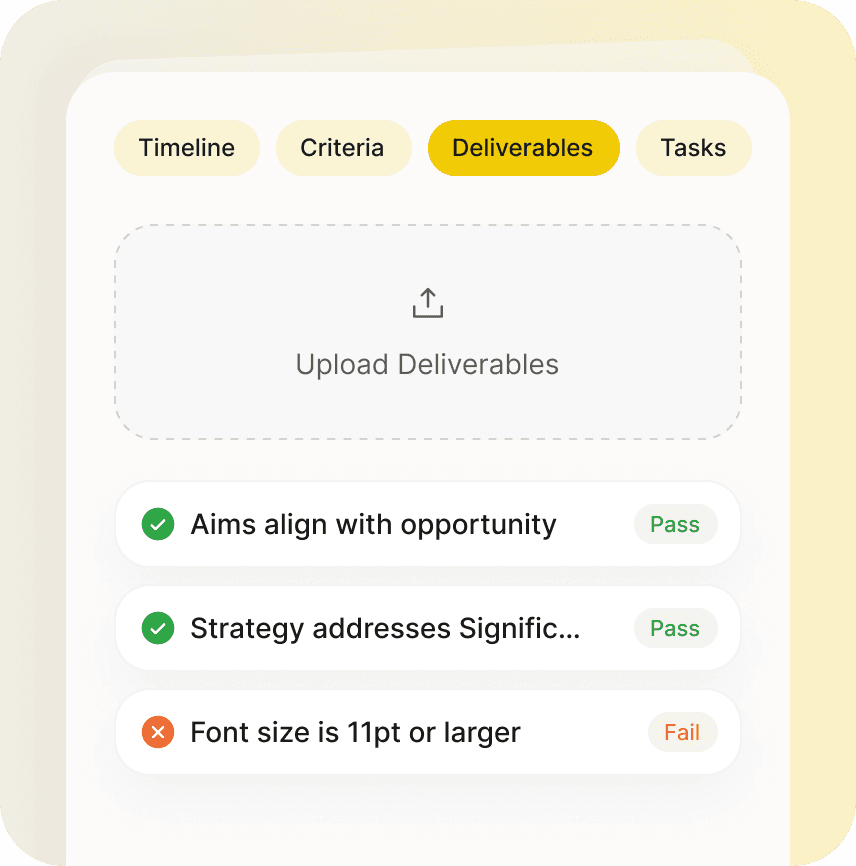
Check every proposal document before submission, so that you always put your best foot forward.
•
Ensure structural sponsor requirements are met
•
Enforce compliance and formatting
•
Measure responsiveness to the solicitation
Measure responsiveness to the solicitation
•
Operationalize internal guidelines and rules
Operationalize internal guidelines and rules
Frequently asked questions
Answers to questions we typically hear from university research offices.
Frequently asked questions
Answers to questions we typically hear from university research offices.
Where does Origami fit into my current workflow?
Origami picks up after an opportunity is identified and carries the proposal through to submission. It isn't a grant discovery database, and it doesn't replace your research administration system of record (eRA). It's the coordination and quality-control layer in between, ensuring every outgoing application is as strong as it can be.
How is Origami different from ChatGPT, Claude, or Copilot?
General-purpose assistants are helpful for ad hoc tasks, but repeatable, mission-critical workflows need a specialized AI system like Origami. Accurate at scale - A solicitation and its general instructions can run 200+ pages, more than a chat can reliably hold. Origami is designed to work through every page and cite the source of each requirement down to the sentence, minimizing hallucination risk and building trust. Built for teams - A chatbot works with one person in one thread. Proposal development requires collaboration across PIs, departments, and the research office, which Origami orchestrates in one shared workspace. Maintenance and innovation - Keeping prompts, instructions, and integrations up to date quickly becomes a full-time job. With Origami, that's our job. Origami also improves continuously based on customer feedback, so every customer benefits from each update.
Does Origami write proposals?
No. Origami identifies requirements, flags gaps, and checks drafts for compliance and alignment with the solicitation. The proposal itself is written by your PIs and team, so there's no AI-authorship concern.
Does Origami write proposals?
No. Origami identifies requirements, flags gaps, and checks drafts for compliance and alignment with the solicitation. The proposal itself is written by your PIs and team, so there's no AI-authorship concern.
Does Origami write proposals?
No. Origami identifies requirements, flags gaps, and checks drafts for compliance and alignment with the solicitation. The proposal itself is written by your PIs and team, so there's no AI-authorship concern.
How accurate is it, and can we trust it?
Every requirement links back to the exact text it came from, so nothing has to be accepted blindly. Origami's extraction architecture runs hundreds of parallel AI calls, minimizing hallucination risk. The platform always keeps a person in the loop: your staff review each checklist and can override any review finding. When sponsor guidance is ambiguous or contradictory, Origami pulls together the relevant cited passages for your interpretation.
What does a proposal review check?
Reviews compare a draft against the source requirements: required sections, formatting and structural rules, and responsiveness to what the sponsor asked for. They also check for internal consistency and when available, how well the proposal addresses past feedback. Each finding cites both the sponsor's requirement and the relevant passage in the draft. You can run reviews as often as you like while drafting, not just once before submission.
How do I justify the cost of Origami?
Origami strengthens your research enterprise on two fronts: Competitiveness - Funding agencies are increasingly using AI to down-select applications. Origami’s AI review helps you get ahead of this, so you’re never surprised. If Origami helps your office secure even one more award a year, it typically pays for itself. Productivity - Research teams typically save ~15 hours per proposal by using Origami end to end instead of running the process manually. Over a year, that adds up to roughly the capacity of an additional team member.
Who uses Origami? Do PIs need an account?
Central and departmental research administrators and proposal development staff build checklists, coordinate contributors, and run reviews. PIs and collaborators get a role-specific checklist via a secure link, with no login required, and can upload their documents directly.
Which funders does Origami support?
Origami works with all federal agencies, foundations, and nonprofits. It handles complex, multi-part solicitations and can account for your institution's internal requirements alongside the sponsor's.
Which funders does Origami support?
Origami works with all federal agencies, foundations, and nonprofits. It handles complex, multi-part solicitations and can account for your institution's internal requirements alongside the sponsor's.
Which funders does Origami support?
Origami works with all federal agencies, foundations, and nonprofits. It handles complex, multi-part solicitations and can account for your institution's internal requirements alongside the sponsor's.
Does Origami train AI models on our data?
No. Your proposals and documents are never used to train AI models. That's our policy, and it's backed by our agreements with the AI model providers we work with.
Does Origami train AI models on our data?
No. Your proposals and documents are never used to train AI models. That's our policy, and it's backed by our agreements with the AI model providers we work with.
Does Origami train AI models on our data?
No. Your proposals and documents are never used to train AI models. That's our policy, and it's backed by our agreements with the AI model providers we work with.
How is our data protected?
Origami adheres to leading security standards. Data is hosted in the United States and encrypted in transit and at rest. Each institution's data is separated from every other customer's, and role-based access controls ensure people only see the proposals they're meant to. You always own your data, and Origami claims no rights to your proposals or documents.
How long does setup take?
You can build your first checklist on day one. A full rollout, including loading your institution's policies and templates and setting up single sign-on, typically takes about a month of light collaboration with your administrators.
How long does setup take?
You can build your first checklist on day one. A full rollout, including loading your institution's policies and templates and setting up single sign-on, typically takes about a month of light collaboration with your administrators.
How long does setup take?
You can build your first checklist on day one. A full rollout, including loading your institution's policies and templates and setting up single sign-on, typically takes about a month of light collaboration with your administrators.
See if Origami is right for your research office
•
Share your office's challenges
•
Receive a personalized demo of Origami
•
Join our low-commitment Pilot Program
Join our low-commitment Pilot Program
Thanks for your interest in Origami!
You should receive an email from me (karthik@origamigrants.com) shortly. If it doesn’t arrive in a few minutes, please check your spam folder or reach out directly with any questions.
If easier, you can also book time on my calendar directly.
Looking forward to connecting,
Karthik Kumar
Co-Founder & CEO
